Man Draws Perfect Circle Then Has Seizure
A Beautiful Mind: Brain Injury Turns Man Into Math Genius
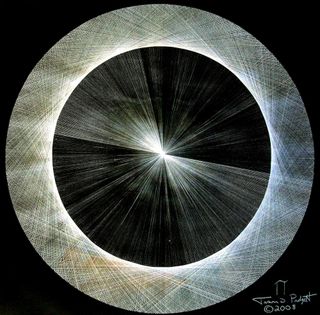
In 2002, two men savagely attacked Jason Padgett outside a karaoke bar, leaving him with a astringent concussion and postal service-traumatic stress disorder. But the incident also turned Padgett into a mathematical genius who sees the world through the lens of geometry.
Padgett, a piece of furniture salesman from Tacoma, Washington, who had very petty interest in academics, adult the ability to visualize complex mathematical objects and physics concepts intuitively. The injury, while devastating, seems to take unlocked function of his brain that makes everything in his earth announced to have a mathematical structure.
"I see shapes and angles everywhere in real life" — from the geometry of a rainbow, to the fractals in water spiraling downward a drain, Padgett told Live Science. "It's only actually beautiful." [Anthology: The World'south Most Beautiful Equations]
Padgett, who just published a memoir with Maureen Seaberg called "Struck by Genius" (Houghton Mifflin Harcourt, 2014), is one of a rare set of individuals with acquired savant syndrome, in which a normal person develops prodigious abilities after a astringent injury or illness. Other people have developed remarkable musical or artistic abilities, but few people accept caused mathematical faculties like Padgett'due south.
Now, researchers have figured out which parts of the man'south encephalon were rejiggered to allow for such savant skills, and the findings suggest such skills may lie dormant in all man brains.
'Struck by genius'
Before the injury, Padgett was a self-described jock and partyer. He hadn't progressed across than pre-algebra in his math studies. "I cheated on everything, and I never cracked a book," he said.
Just all that would change the night of his attack. Padgett recalls being knocked out for a dissever second and seeing a bright wink of lite. 2 guys started chirapsia him, boot him in the head as he tried to fight dorsum. Afterwards that nighttime, doctors diagnosed Padgett with a severe concussion and a bleeding kidney, and sent him home with pain medications, he said.
Presently after the attack, Padgett suffered from PTSD and debilitating social anxiety. But at the same time, he noticed that everything looked different. He describes his vision as "detached picture frames with a line connecting them, simply nonetheless at real speed." If y'all retrieve of vision every bit the brain taking pictures all the fourth dimension and smoothing them into a video, it'southward every bit though Padgett sees the frames without the smoothing. In add-on, "everything has a pixilated look," he said.
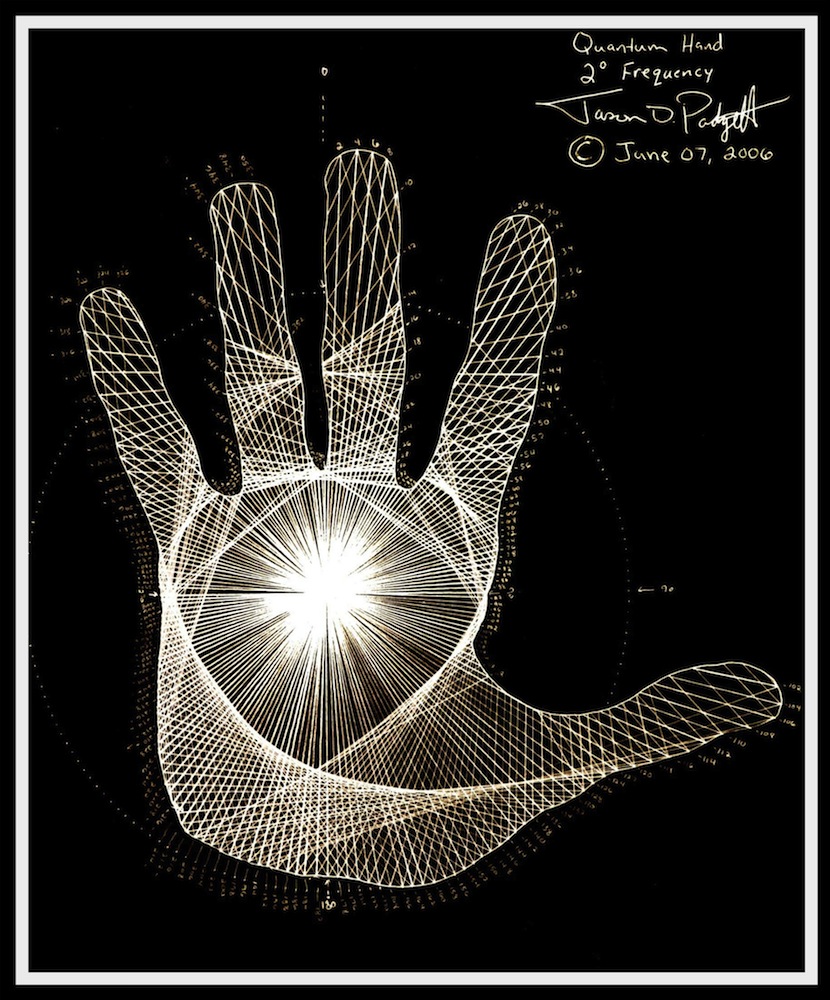
With Padgett's new vision came an phenomenal mathematical cartoon power. He started sketching circles made of overlapping triangles, which helped him understand the concept of pi, the ratio of a circle's circumference to its diameter. There's no such thing as a perfect circumvolve, he said, which he knows because he tin can e'er run across the edges of a polygon that approximates the circumvolve. [Gallery: Encounter Padgett'southward Amazing Mathematical Drawings]
Padgett dislikes the concept of infinity, because he sees every shape as a finite construction of smaller and smaller units that approach what physicists refer to as the Planck length, idea to exist the shortest measurable length.
After his injury, Padgett was drawing complex geometric shapes, but he didn't have the formal preparation to empathize the equations they represented. 1 solar day, a physicist spotted him making these drawings in a mall, and urged him to pursue mathematical preparation. At present Padgett is a sophomore in college and an aspiring number theorist.
Padgett'due south remarkable abilities garnered the interest of neuroscientists who wanted to empathize how he developed them.
Beautiful mind
Berit Brogaard, a philosophy professor now at the University of Miami, in Coral Gables, Florida, and her colleagues scanned Padgett's brain with functional magnetic resonance imaging (fMRI) to understand how he acquired his savant skills and the synesthesia that allows him to perceive mathematical formulas as geometric figures. (Synesthesia is a phenomenon in which 1 sense bleeds into another.) [Top 10 Mysteries of the Listen]
"Acquired savant syndrome is very rare," Brogaard said, adding that but 15 to 25 cases take always been described in medical studies.
Functional magnetic resonance imaging measures changes in blood period and oxygen use throughout the brain. During scans of Padgett, the researchers showed the man real and nonsense mathematical formulas meant to conjure images in his mind.
The resulting scans showed significant activity in the left hemisphere of Padgett'due south brain, where mathematical skills have been shown to reside. His brain lit up almost strongly in the left parietal cortex, an expanse behind the crown of the head that is known to integrate information from dissimilar senses. There was also some activation in parts of his temporal lobe (involved in visual retentiveness, sensory processing and emotion) and frontal lobe (involved in executive function, planning and attending).
But the fMRI merely showed what areas were active in Padgett'south brain. In order to show these detail areas were causing the human's synesthesia, Brogaard'southward team used transcranial magnetic stimulation (TMS), which involves zapping the brain with a magnetic pulse that activates or inhibits a specific region. When they zapped the parts of Padgett's parietal cortex that had shown the greatest action in the fMRI scans, it made his synesthesia fade or disappear, co-ordinate to a study published in August 2013 in the journal Neurocase.
Brogaard showed, in another report, that when neurons dice, they release brain-signaling chemicals that can increase brain activity in surrounding areas. The increased activity unremarkably fades over time, merely sometimes it results in structural changes that can cause brain-action modifications to persist, Brogaard told Alive Science.
Scientists don't know whether the changes in Padgett's brain are permanent, but if he had structural changes, information technology'south more probable his abilities are here to stay, Brogaard said.
The savant in everyone
And so practice abilities similar Padgett's lie dormant in anybody, waiting to exist uncovered? Or was there something unique about Padgett's encephalon to begin with?
Near likely, there is something dormant in everyone that Padgett tapped into, Brogaard said. "It would be quite a coincidence if he were to have that particular special brain then have an injury," she said. "And he's not the only [acquired savant]."
In improver to caput injuries, mental disease has also been known to reveal latent abilities. And Brogaard and others have done studies that suggest zapping the brains of normal people using TMS can temporarily bring out unusual mathematical and creative skills.
It's e'er possible that having savant skills may come with trade-offs. In Padgett's example, he developed fairly severe post-traumatic stress disorder and obsessive-compulsive disorder, and he still finds it difficult to announced in public.
Withal Padgett wouldn't change his new abilities if he could. "It's so good, I can't even describe it," he said.
Follow Tanya Lewis on Twitter and Google+ . Follow the states @livescience , Facebook & Google+ . Original article on Live Science.
Source: https://www.livescience.com/45349-brain-injury-turns-man-into-math-genius.html
0 Response to "Man Draws Perfect Circle Then Has Seizure"
إرسال تعليق